
Categories
AdvisoryPublished December 16, 2025
California AB 130 Explained: What It Means for New Construction and Home Prices in El Dorado Hills & Sacramento

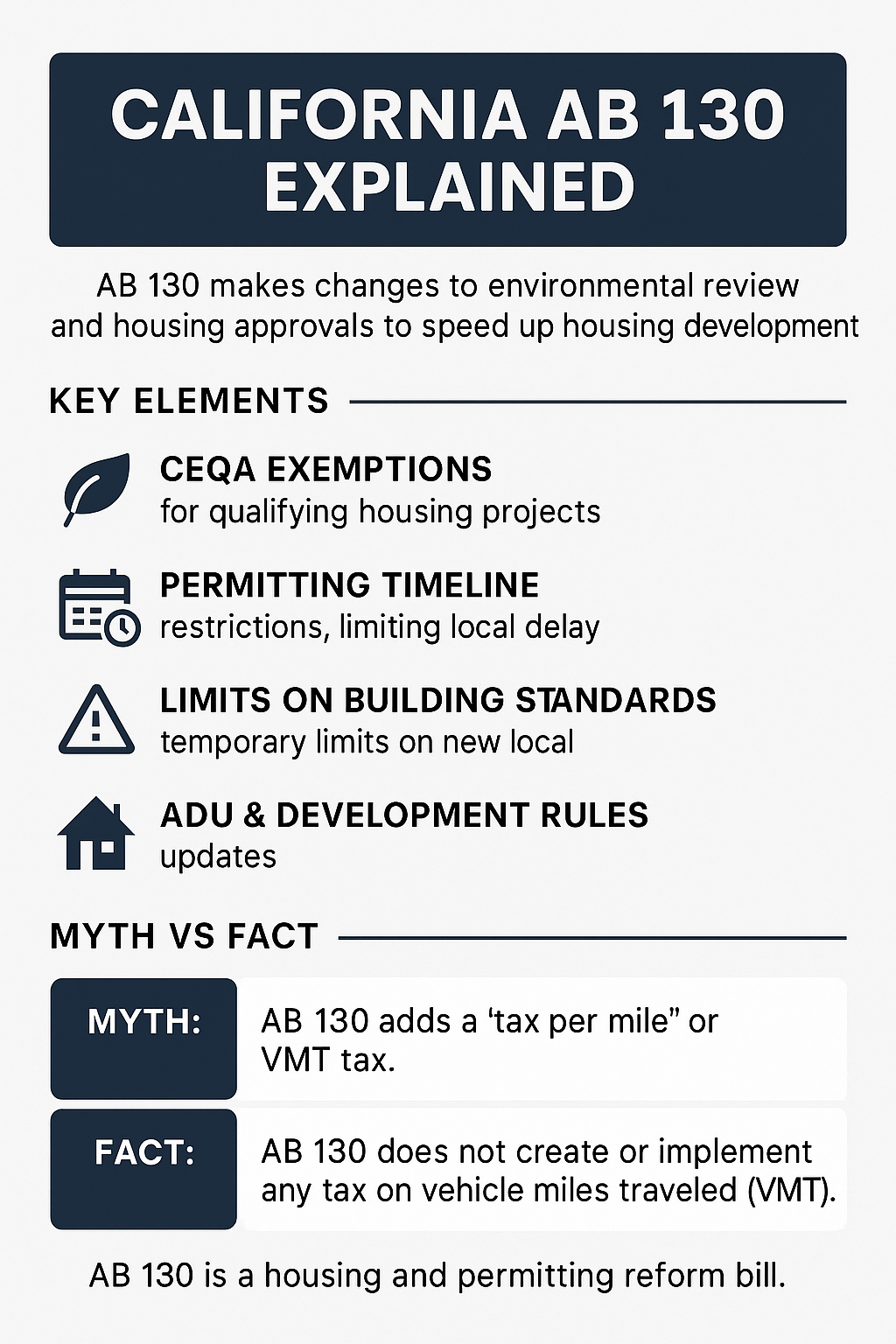
California’s housing market is shaped as much by regulation as it is by interest rates — and a new law is already changing how housing gets built across the state.
In mid-2025, Governor Newsom signed Assembly Bill 130 (AB 130) into law. While it hasn’t dominated headlines, AB 130 directly affects how quickly and predictably new homes can be approved and built — a critical issue in supply-constrained markets like El Dorado Hills, Folsom, Granite Bay, and Sacramento.
This article explains what AB 130 does, when it takes effect, how it impacts new construction locally, and what it could mean for home prices — while also clearing up a common myth circulating online.
What Is California AB 130?
AB 130 is a housing and permitting reform bill, not a tax bill and not a density mandate.
Its primary purpose is to reduce delays, uncertainty, and excessive cost escalation caused by California’s development approval process — particularly under the California Environmental Quality Act (CEQA).
Key provisions include:
- New CEQA exemptions for qualifying residential housing projects, especially infill development in urbanized areas
- More predictable permitting rules, preventing local agencies from changing standards mid-review
- Temporary limits on new local residential building standards, improving cost certainty for builders
- Clarifications and updates to ADU rules, limiting excessive local fees and restrictions
For communities like El Dorado Hills and Sacramento, where entitlement timelines can materially affect feasibility, this is a meaningful structural change.
AB 130 Timeline: When the Law Takes Effect
- June 30, 2025 – AB 130 signed into law
- July 1, 2025 – Major CEQA streamlining provisions become effective
- 2025–2031 – Certain limits on new local residential building standards apply
- Ongoing – Cities and counties must comply with updated permitting and review requirements
Projects already in planning stages across El Dorado County and Sacramento County may now benefit from clearer and faster review pathways.
How AB 130 Affects New Construction in El Dorado Hills & Sacramento
Faster, More Predictable Approvals
One of the biggest challenges to housing production locally has been delay risk — not just zoning. CEQA challenges and prolonged review timelines can stall projects for months or years.
AB 130 reduces that uncertainty by creating statutory CEQA exemptions for qualifying housing projects. This does not eliminate environmental protections, but it does limit procedural abuse and endless delays.
Why This Matters Locally
In areas like:
- El Dorado Hills
- Folsom
- Rancho Cordova
- Greater Sacramento
Even modest reductions in approval timelines can:
- Lower development costs
- Improve project feasibility
- Encourage infill and mid-density housing
That matters in a region where housing demand continues to outpace supply.
Myth vs Fact: Does AB 130 Create a “Tax Per Mile” on Drivers?
There has been confusion online suggesting that AB 130 creates a new “tax per mile” or Vehicle Miles Traveled (VMT) tax. That claim is false.
AB 130 does not create, authorize, or implement any VMT tax.
The bill contains no provisions for:
- Per-mile driving fees
- Tracking individual drivers
- New transportation taxes
The confusion stems from the fact that California already uses VMT as a planning metric under CEQA to analyze traffic impacts of development projects. This has existed for years and is not a tax.
Separately, California has explored voluntary pilot programs studying mileage-based road charges as a potential long-term alternative to gas taxes. These pilots are:
- Not permanent
- Not statewide
- Not connected to AB 130
Bottom line: AB 130 affects how homes are approved and built — not how drivers are taxed.
How AB 130 Could Affect Home Prices in El Dorado Hills & Sacramento
Short Term (2025–2026)
- Housing inventory remains constrained
- Prices remain supported by limited supply
- Any impact will be gradual and localized
AB 130 does not create instant housing or immediate price relief.
Medium to Long Term (2027+)
If faster approvals translate into more viable projects:
- Housing supply can increase incrementally
- Price growth may slow over time
- Market stability improves
In high-desirability areas like El Dorado Hills, AB 130 is more likely to moderate price acceleration than reduce prices outright.
What This Means for Buyers, Sellers, and Investors
Buyers:
AB 130 is a positive structural shift, but patience is required. Supply improvements take time.
Sellers:
Near-term inventory remains tight. Market leverage is largely unchanged today.
Investors & Developers:
Reduced entitlement risk and faster approvals materially improve feasibility, especially for infill and multifamily projects in the Sacramento region.
Final Thoughts
AB 130 does not solve California’s housing shortage on its own — but it addresses one of the most persistent bottlenecks: bureaucratic delay.
For El Dorado Hills and Sacramento, the impact will be gradual but meaningful — supporting healthier housing supply over time while preserving market stability.
And despite online rumors, AB 130 does not impose a tax on vehicle miles traveled.
If you want to understand how this law could affect your specific neighborhood, property, or investment strategy, that’s where the real value lies.
_____________________________________________________________________________________
❓ FAQ SECTION
Does AB 130 affect El Dorado Hills specifically?
Yes. AB 130 applies statewide and affects how housing projects are reviewed and approved in El Dorado County, including El Dorado Hills.
Will AB 130 lower home prices in Sacramento?
Not immediately. Over time, faster approvals may increase housing supply and slow price growth, but it is not expected to reduce prices outright.
Does AB 130 create a tax on vehicle miles traveled?
No. AB 130 does not create or authorize any VMT or “tax per mile.”
When does AB 130 take effect?
Most provisions took effect July 1, 2025, with certain rules applying through 2031.
Does AB 130 eliminate CEQA?
No. It creates targeted exemptions and streamlines review for qualifying housing projects.
...

Shannon and Jon Yoffie
Co-Founders | Yoffie Real Estate Group | Keller Williams
or another way