

Categories
AdvisoryWhat Would You Actually Owe If You Sold This Year?
Two posts back, we covered the difference between a repair and a capital improvement, because the IRS treats them differently and it changes what you owe when you sell. Last week, we covered the one tax rule California gives surviving spouses on a community property home, a rule most sellers have never checked against their own situation. Both posts left the same question sitting on the table: okay, but what does that actually mean in dollars for your house? This week we built a calculator that answers it.
What Goes Into Your Basis
Your basis is not your purchase price. It is your purchase price plus the cost of every capital improvement you made along the way, a new roof, a room addition, a remodeled kitchen, minus a few adjustments most sellers never run into. That higher number is what actually gets subtracted from your sale price to find your gain, and it is the reason two neighbors who bought identical houses at the same price can owe very different amounts when they sell. We wrote about what qualifies as an improvement versus a repair, and built a free one-page log for tracking it, in last month's post. If you have not started that log yet, today is still a fine day to start.
Your Gain, the Exclusion, and What Is Left
Take your sale price, subtract your selling costs, and you get what the IRS calls your amount realized. Subtract your basis from that, and you get your gain. From there, Section 121 of the tax code excludes up to $250,000 of that gain from federal tax for a single filer, or up to $500,000 for a married couple filing jointly, as long as you owned and lived in the home as your main residence for at least two of the five years before the sale. For a lot of long-time owners, that exclusion covers the entire gain and the math stops there. For others, especially single filers and owners in homes that have appreciated well past what the exclusion covers, there is a real number left over, and that is the part most sellers never actually calculate before they list.
What California Does With What Is Left
California does not have a separate capital gains rate the way the federal government does. It taxes your gain as ordinary income, at rates up to 13.3 percent, and it does not give you a discount for how long you owned the home. That sits on top of whatever federal long-term capital gains rate applies to your taxable gain, which for most sellers lands at 15 percent. It only climbs to 20 percent once taxable income clears roughly $545,000 for a single filer or $614,000 for a married couple filing jointly in 2026, and it can drop to 0 percent if your income stays under roughly $49,000 or $99,000. Most sellers fall somewhere in the middle of that range, which is exactly why running your own numbers matters more than reading a general rule.
If You Inherited Your Share
California is one of only nine community property states, and it gives surviving spouses something almost nowhere else does: both halves of the home's value, not just the half your spouse owned, can step up to fair market value on the date of death. We walked through the mechanics and a worked example in last week's post. If that applies to you, the calculator has a second tab built specifically to compare your tax with the step-up against what it would be without it, so you can see the difference in your own numbers rather than someone else's example.
Running the Numbers
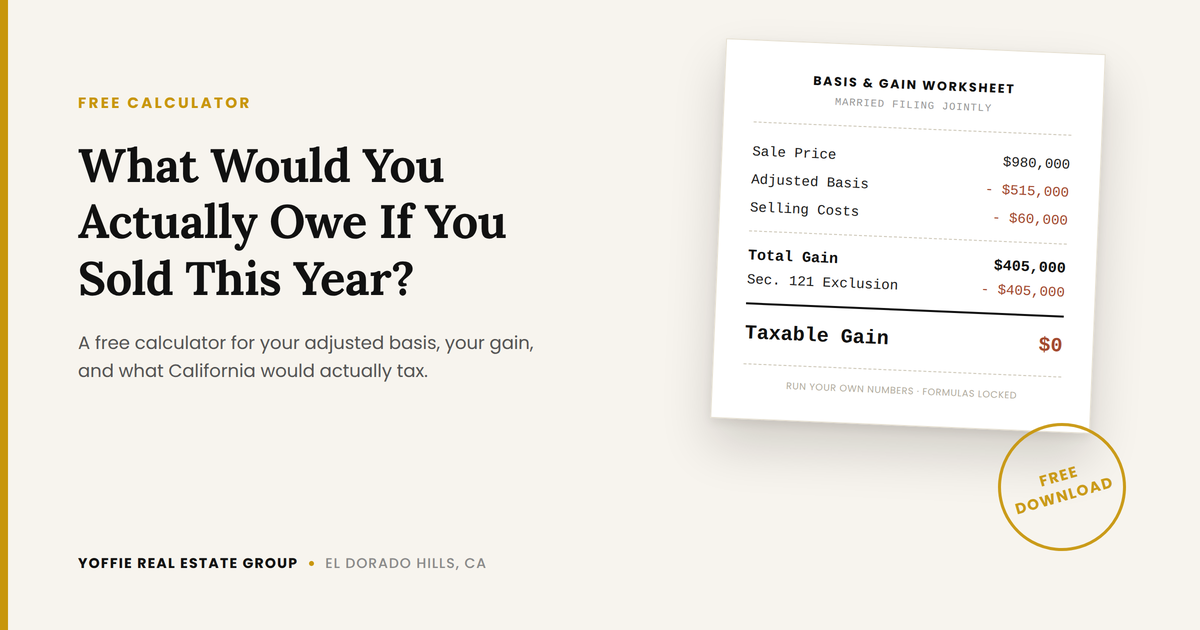
Here is what that looks like in practice. Say a married couple bought their El Dorado Hills home in 2011 for $420,000, put $95,000 into documented capital improvements over the years, and sell in 2026 for $980,000 with $60,000 in selling costs. Their basis is $515,000, their amount realized is $920,000, and their gain is $405,000. Filing jointly, their $500,000 exclusion covers all of it. Nothing owed, federal or state.
Change one detail, same numbers, but the seller is filing single. The exclusion drops to $250,000, which leaves $155,000 of gain exposed. Between the federal long-term capital gains rate and California's ordinary income treatment, the combined bill on that leftover amount often lands somewhere between a quarter and a third of it, so call it $40,000 to $50,000 in this example, depending on the seller's total income and filing details. Same house, same improvements, same sale price. Very different outcome, and the only way to know which situation you are actually in is to run your own figures.
What the Calculator Actually Does
It is a two-tab Excel workbook. The first tab is the basis and gain estimator described above: enter your purchase price, sale price, selling costs, and a log of your capital improvements, and it calculates your adjusted basis, applies the exclusion, and estimates what is left. The second tab is the California community property comparison for surviving spouses. Every formula cell is locked so the math cannot be accidentally overwritten. Only the fields you are meant to fill in, your own numbers and dates, are open for editing. It is free, and there is no obligation attached to downloading it.
One Honest Limit
This calculator uses simplified example tax rates and the exclusion rules described above. It does not account for depreciation recapture, the alternative minimum tax, the net investment income tax, or every exception in the tax code, and it is not a substitute for a conversation with your CPA before you close. What it is built to do is give you a realistic starting estimate before you list, instead of finding out for the first time at closing. If your next question after running it is what your home is actually worth in today's market rather than what you would owe on the sale, that is a separate calculation, and our Smart Seller Pricing System is built for that side of it.
Frequently Asked Questions
What is my adjusted basis when I sell my home?
Your adjusted basis is what you paid for the home, plus the cost of any capital improvements you made along the way, minus a small set of adjustments most sellers never run into. It is not just your purchase price, and it is the number the IRS actually uses to calculate your gain.
How much of my home sale profit is tax-free?
Under Section 121, up to $250,000 of gain is excluded from federal tax for a single filer, and up to $500,000 for a married couple filing jointly, as long as you owned and lived in the home as your main residence for at least two of the five years before the sale. Gain above that exclusion is what actually gets taxed.
Does California tax my home sale gain the same way the IRS does?
No. California does not have a separate capital gains rate. It taxes your gain as ordinary income, at rates up to 13.3 percent, with no discount for how long you owned the home, on top of whatever federal long-term capital gains rate applies to your taxable gain.
What if I inherited part of the house from a spouse who passed away?
California is a community property state, which means both halves of the home's value, not just the half your spouse owned, can step up to fair market value on the date of death. That can erase most or all of the gain on a later sale. The calculator's second tab compares your tax with the step-up against what it would be without it.
Is this calculator the same as advice from a CPA?
No. It uses simplified example tax rates and does not account for depreciation recapture, the alternative minimum tax, the net investment income tax, or every exception in the tax code. It is built to give you a realistic starting estimate before you list, not a substitute for a conversation with your CPA before you close.
Do I need to be selling soon to use this?
No. It is just as useful for planning ahead, whether you are deciding when to sell, whether one more improvement is worth making before you list, or simply want to know where you stand. There is no obligation attached to using it.
Free two-tab calculator, formulas locked, just your own numbers.
About the author: Jon Yoffie is co-founder of Yoffie Real Estate Group at 4359 Town Center Blvd, Ste 217, El Dorado Hills, CA 95762. He advises buyers, sellers, and homeowners across El Dorado Hills, Serrano, Blackstone, Folsom, and Cameron Park. Reach him at (916) 941-6566 or jon@yoffierealestate.com.
Jon Yoffie is a real estate advisor, not a financial, tax, or legal advisor. This post and the calculator it links to are for general education only and are not tax, legal, or financial advice. Your basis, your filing status, and your total income all change the answer. Please talk to a CPA before making decisions based on it. Figures reflect tax law current as of publish date and are subject to change.
