
Categories
AdvisoryPublished September 30, 2026
What Your November Property Tax Bill Actually Means (El Dorado Hills)

Homeowner Guide
What Your November Property Tax Bill Actually Means
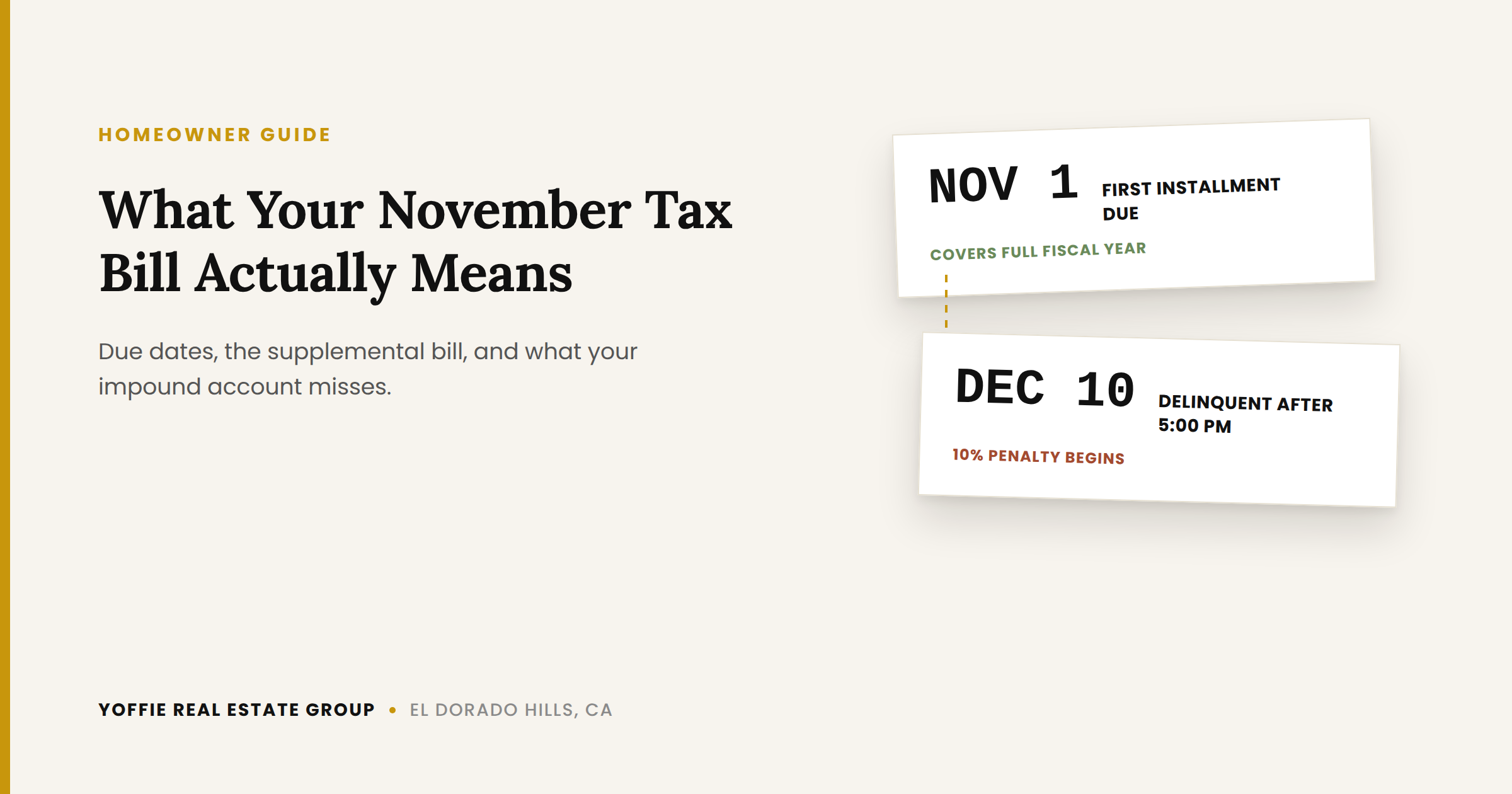
Your first installment is due November 1 and turns delinquent after December 10. Here is what that bill actually covers, what a supplemental bill is, and why your impound account might not cover everything you expect.
If you bought a home in El Dorado Hills this year, the property tax bill that lands in your mailbox in late October or early November is the first one with your name on it. It is worth ten minutes to understand before December 10 arrives, because the bill itself is more forgiving than most new owners assume, and the one that can genuinely catch you off guard is not this one.
What the November Bill Actually Covers
El Dorado County runs its property tax year from July 1 to June 30. Secured tax bills for that full year go out by November 1, and the county splits the total into two installments instead of asking for it all at once. The bill you get is for the entire fiscal year already underway, not a new charge on top of anything.
The two installments run on separate clocks, and mixing them up is the single most common source of late-payment penalties among first-time owners.
| Installment | Due | Delinquent After | Late Penalty |
|---|---|---|---|
| First | November 1 | December 10, 5:00 PM | 10 percent |
| Second | February 1 | April 10, 5:00 PM | 10 percent plus a flat fee |
The penalty is not prorated and not gentle. Miss December 10 by one day and the county adds 10 percent to that installment, full stop. If you plan to pay by e-check or online bill pay, submit it at least ten days before the deadline. Processing delays do not count as an excuse, and the county has heard every version of that argument.
The Supplemental Bill Nobody Warns You About
This is the one that actually surprises new buyers, and it has nothing to do with the November bill above. When you buy a home, the county reassesses it at your purchase price. If that price is higher than what the previous owner was taxed on, which is nearly always true after a few years of appreciation, the difference generates a separate supplemental tax bill.
The supplemental bill is prorated for the months remaining in the fiscal year from your closing date, and it arrives on its own schedule, separate from the regular annual bill and often months after you close escrow. Assessor's offices routinely run behind, so it is not unusual for a supplemental bill to show up nine months to over a year after you move in, sometimes as more than one bill if your purchase crossed a fiscal year boundary.
Nothing about this means you did anything wrong or missed a payment. It means the assessment caught up to your actual purchase price, and the county is billing you for the gap. Budgeting for it ahead of time turns a surprise into a line item.
What Your Impound Account Does and Does Not Cover
If your loan has an impound account, also called an escrow account, your lender collects roughly one-twelfth of your estimated annual property tax with every mortgage payment and pays the county directly when each installment comes due. That covers the regular secured bill described above, the one based on the assessed value your lender used when your loan was set up.
It typically does not cover a supplemental bill. Your lender calculated your monthly impound amount using the assessed value on file at closing, not the reassessed value that generates the supplemental bill later. That bill goes directly to you, not through your loan servicer, unless you specifically ask your lender to fold it in. Most buyers do not know to ask, which is exactly why this one catches people off guard even though it is a completely normal part of buying in El Dorado Hills.
Bought recently and not sure what to expect on your own bill, or weighing what a purchase this year would mean for next year's tax picture? We walk buyers and sellers through exactly this, no obligation attached.
Talk to Our TeamFrequently Asked Questions
When is the first property tax installment due in El Dorado County?
The first installment is due November 1 and becomes delinquent, with a 10 percent penalty, after December 10 at 5:00 PM. The second installment is due February 1 and becomes delinquent after April 10.
What is a supplemental tax bill?
A supplemental tax bill is issued when the county reassesses a property after a change of ownership or new construction. It covers the difference between the prior assessed value and the new value, prorated for the months remaining in the fiscal year, and arrives separately from the regular annual bill, sometimes many months after closing.
How does an impound account work for property taxes?
Your lender collects a portion of your estimated annual property tax with each mortgage payment and pays the county on your behalf when each installment is due. It is based on the assessed value on file at loan setup, so it generally does not cover a later supplemental bill, which is billed to you directly.
This is general information about how El Dorado County property taxes work, not tax or legal advice specific to your situation. Confirm current dates, rates, and your own bill details with the El Dorado County Treasurer-Tax Collector or your CPA.

Shannon and Jon Yoffie
Co-Founders | Yoffie Real Estate Group | Keller Williams
or another way