
Categories
AdvisoryPublished September 24, 2026
Should You Sell in El Dorado Hills Before December 31?

Seller Strategy
Should You Sell Before December 31? What Changes and What Doesn't
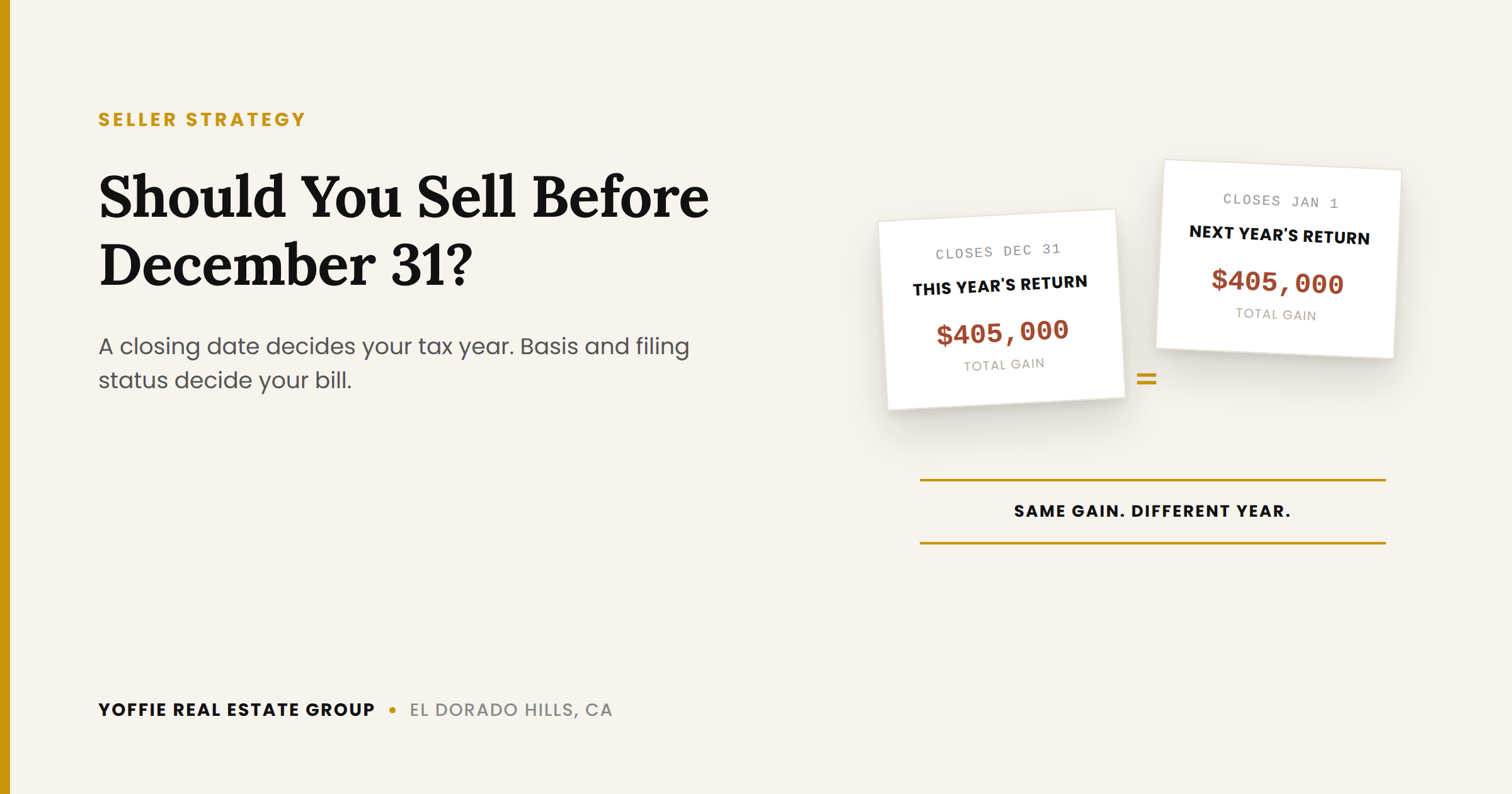
A closing date changes which tax year you file your sale in. For almost everyone, that's the only thing it changes.
Every fall we get some version of the same question: should a seller push to close before December 31, or does waiting until January actually save money? The honest answer is that the calendar does far less work than most sellers assume. What actually determines your tax bill is your basis and your filing status against the federal exclusion, not which side of New Year's Eve your closing lands on.
What the calendar actually changes
Closing in December means the sale shows up on this year's tax return. Closing in January means it shows up on next year's. That's it. The IRS's ownership-and-use test, the requirement that you've owned and lived in the home as your primary residence for at least 2 of the last 5 years before the sale, runs off your own history in the house. It doesn't reset, extend, or improve based on which month you close in.
There's one place the calendar can matter, and it has nothing to do with the home sale rules themselves. A large one-time gain adds to your income for that tax year, and California's SALT deduction cap phases out above $505,000 in MAGI for joint filers ($252,500 for married filing separately). If a sale pushes your income across a threshold like that in one direction or the other, the timing of other income in the same year can matter. That's a conversation for your CPA, not something to work out from a blog post.
What actually determines the bill
Take the same example we built the Basis and Gain Calculator around. A couple bought a home in 2011 for $420,000 and put $95,000 into genuine capital improvements since, a remodeled kitchen, a new roof, a room addition. That puts their adjusted basis at $515,000, not $420,000. They sell in 2026 for $980,000 with $60,000 in selling costs. The gain works out to $405,000, calculated the same way whether the sale closes on December 15 or January 15.
| Sale price | $980,000 |
| Adjusted basis | - $515,000 |
| Selling costs | - $60,000 |
| Total gain | $405,000 |
Filing jointly, the $500,000 federal exclusion under Section 121 covers that entirely. They owe nothing, in December or January. Filing single, only $250,000 is covered, which leaves $155,000 exposed, and the combined federal and California tax on that typically lands between $40,000 and $50,000, again regardless of which month the sale closes. Filing status and basis decided the outcome. The calendar was never in the equation.
Run your own numbers before you decide anything
If you're weighing a year-end close against waiting, the useful exercise isn't picking a date, it's finding your own basis and gain first. We built a free calculator for exactly that. Formulas are locked, you enter your purchase price, improvements, and expected sale price, and it shows you where you actually land under both filing statuses.
Get the Basis and Gain Calculator. If you'd rather talk through your specific situation and pricing strategy directly, request a Smart Pricing Analysis and we'll walk through it together.
Want the full pricing picture, not just the tax math? Request a Smart Pricing Analysis and we'll build your numbers together.
Frequently Asked Questions
Does closing in December versus January change my tax bill?
It changes which tax year the sale is reported in, not the amount of gain or the tax rate that applies to it. Your adjusted basis, your selling costs, and your Section 121 exclusion are calculated the same way regardless of the closing date.
Does the 2-of-5-year ownership and use test reset if I sell late in the year?
No. The test looks at whether you owned and used the home as your primary residence for at least 2 of the 5 years immediately before the sale date. It's based on your own history in the property, not the calendar year, and closing a few weeks earlier or later doesn't change whether you meet it.
Can I split a sale across two tax years to reduce what I owe?
A single sale closes on a single date and is reported entirely in that tax year. You can't split one sale's gain across two years by choosing an installment structure without specific tax planning around it, and that kind of structuring needs a CPA's involvement, not a closing-date shift.
Is there a deadline I need to hit to use the Section 121 exclusion?
No annual deadline applies. The exclusion is available on any sale where you meet the 2-of-5-year ownership and use test and haven't claimed it on another home sale within the past 2 years. It isn't tied to a calendar year cutoff.
Does my closing date affect my adjusted basis or my gain calculation?
No. Adjusted basis is your purchase price plus qualifying capital improvements, and gain is your sale price minus selling costs minus that basis. Neither calculation references the date you close.
Should I wait until January if I'm close to exceeding my exclusion?
Waiting doesn't change your exclusion amount, since that's set by your filing status, not your closing date. The one scenario where timing genuinely matters is if a large gain would push your income across an unrelated threshold, like California's SALT deduction phase-out, in a way that affects other parts of your return. That's specific enough to your full financial picture that it needs a CPA, not a rule of thumb.
This is meant to help you understand the general picture, not to replace a CPA. Your own basis, filing status, and total income will change your answer, so talk to one before deciding anything based on it.

Shannon and Jon Yoffie
Co-Founders | Yoffie Real Estate Group | Keller Williams
or another way