

Categories
Advisory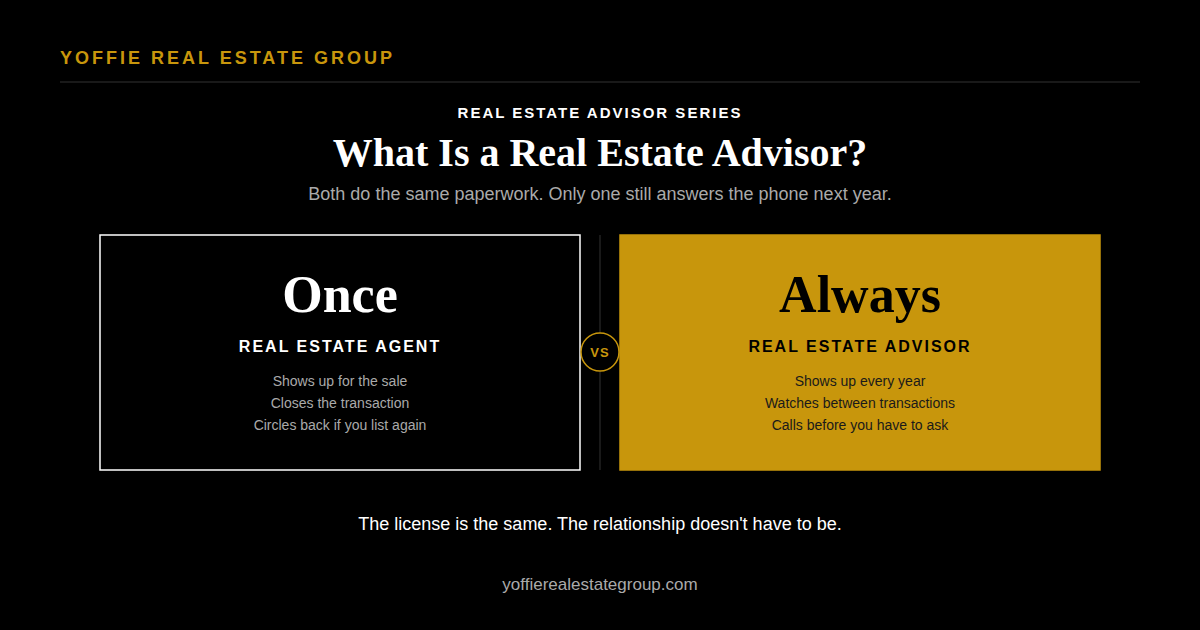
What Is a Real Estate Advisor? An El Dorado Hills Homeowner's Guide to the Difference
By Jon Yoffie | Yoffie Real Estate Group | Published September 9, 2026
A real estate advisor is someone who works with you as a homeowner year-round, not just during a purchase or sale, watching insurance, taxes, remodeling value, and market conditions on your behalf between transactions instead of only showing up when there's a commission at the end of it. A real estate agent, in the common use of the word, is someone hired for a single transaction and largely goes quiet once it closes. The two terms describe a difference in relationship, not a difference in license.
That last part surprises people, so it's worth saying plainly before anything else: in California, "advisor" isn't a separate credential. Anyone using it is still operating under the same license as anyone using "agent." The difference is entirely in how the job gets done after that.
The Legal Answer: There Isn't One
The California Department of Real Estate issues exactly two license types: real estate salesperson and real estate broker. That's it. There's no "advisor" license, no separate exam, no additional certification the state hands out for the word. If someone tells you a real estate advisor is a different, more qualified kind of professional than a real estate agent, they're describing a business philosophy, not a legal category, whether they realize it or not.
We think that distinction matters enough to say out loud, partly because we use the word "advisor" ourselves. Calling it a business philosophy instead of a credential isn't a downgrade. It's just accurate, and accuracy is supposed to be the whole point.
The Practical Answer: It's a Relationship, Not a License
If the license is identical, the difference has to show up somewhere else. In our experience it shows up in exactly one place: what happens after closing.
A transactional agent's job, reasonably, ends at the sale. They found the house, negotiated the price, got you to the closing table, and the relationship's core purpose is complete. Most agents work this way, and there's nothing wrong with it. It's simply a narrower job than the word "advisor" implies.
An advisor relationship treats the closing as the start of a much longer conversation, not the end of a short one. That means flagging an insurance coverage gap you didn't know you had. It means knowing which home projects actually change what you owe in taxes when you eventually sell, and which ones don't. It means understanding a California-specific rule like the community property step-up in basis well enough to bring it up before you need it, not after. None of that requires a different license. It requires deciding, as a business, to keep doing the job past the point where the commission has already been paid.
The license is the same. The relationship doesn't have to be.
What This Looks Like in Practice, Not in Theory
It's easy to claim an ongoing relationship in a blog post. It's harder to show it, so here's what that's actually looked like from us this year, not as a promise but as a record.
We started by naming the five things a real estate advisor should be watching between transactions in Why Not a Real Estate Advisor?: insurance, maintenance, remodeling ROI, title and property tax, and refinancing. From there we went deeper on two of the harder ones. What actually counts toward your tax basis when you remodel, and what most homeowners get wrong about it. And because California gives surviving spouses a genuinely unusual tax benefit that almost nobody explains clearly, the community property step-up in basis got its own piece, aimed at a harder moment than the others. On the insurance and maintenance side of that same list, this year's new Zone 0 defensible space rule is a live example: what the rule means for homes in Serrano, Blackstone, and the hillside neighborhoods, and how compliance is already showing up in what homeowners pay for insurance.
None of those four posts had anything to sell in the moment. That's roughly the point. We're a Top 5 team in El Dorado Hills, we've closed more than $85 million over the past two years, and we've advised more than 250 families, and the reason we lead with those numbers here instead of at the top is that they only mean something once you've seen what the work actually looks like.
How to Tell If Your Agent Is Actually Acting as an Advisor
You don't have to take anyone's word for which kind of relationship you have, including ours. A few honest questions tend to answer it fast.
Has anyone reached out to you since your last closing without asking for a referral or a listing in the same breath? Do you know, right now, whether a project you did last year added to your home's tax basis? If your homeowner's insurer left California or changed your policy, did anyone flag it, or did you find out on your own? Would you know who to call first if you inherited a home tomorrow?
If the honest answer to most of those is no, that's not a judgment on the agent you worked with. It's just a sign you had a transactional relationship, which is what most people have, because it's what most agents offer. It only becomes a problem if you assumed you had the other kind.
Curious what an ongoing relationship would actually look like for your home?
No pressure, no pitch. Just a conversation.
Frequently Asked Questions About Real Estate Advisors
What is a real estate advisor?
A real estate advisor is a licensed agent or broker who works with a homeowner on an ongoing basis, not just during a purchase or sale, watching things like insurance coverage, home value, tax basis, and market conditions between transactions rather than only at closing.
Is "real estate advisor" a different license than "real estate agent" in California?
No. The California Department of Real Estate issues two license types, salesperson and broker. "Advisor" describes how someone chooses to work, not a separate credential the state grants.
Does working with a real estate advisor cost more?
Not on a transaction. Commission structures for buying and selling generally don't change based on whether an agent describes themselves as an advisor. What changes is the work that happens between transactions, which most agents don't itemize or bill for separately, us included.
How do I know if my current agent is acting as an advisor?
Look at what's happened since your last closing. If they've reached out with something useful and unprompted, unrelated to asking for a referral or a new listing, that's the pattern. If you haven't heard from them since the sale, you likely have a transactional relationship, which is common and not necessarily a criticism of them.
What's the difference between a real estate advisor and a financial advisor?
A financial advisor is a distinct, separately regulated profession, often licensed through FINRA or the SEC, focused on investments and overall financial planning. A real estate advisor is a real estate agent or broker whose work is scoped to your home and the real estate decisions around it. The two roles overlap at the edges, particularly around home equity, but they're not the same license or the same regulator.
I'm not buying or selling right now. Why would I need a real estate advisor?
Because most of what an advisor actually does happens when you're not buying or selling: tracking home improvements for tax purposes, catching an insurance gap, flagging a property tax issue before it becomes expensive. We covered this specific question in more depth in our first post in this series.
The Bottom Line
"Real estate advisor" isn't a license, a certification, or a title anyone can verify with the state. It's a description of how someone chooses to do the job, and the only real way to judge it is by what they actually do between the transactions, not what they call themselves during one.
Jon Yoffie and Shannon Yoffie of Yoffie Real Estate Group have built their business around the ongoing version of this relationship. This page, and the posts it links to, is meant to be the evidence, not just the claim.
Source: California Department of Real Estate, dre.ca.gov/licensees/, confirming the two license types issued in California, verified September 9, 2026. This post reflects the licensing structure current as of publish date and is for general education, not legal advice about licensing or professional titles.
About the author: Jon Yoffie is co-founder of Yoffie Real Estate Group at 4359 Town Center Blvd, Ste 217, El Dorado Hills, CA 95762. He and Shannon Yoffie advise buyers, sellers, and homeowners across El Dorado Hills, Serrano, Blackstone, Folsom, and Cameron Park. Reach Jon at (916) 941-6566 or jon@yoffierealestate.com.
Jon and Shannon Yoffie are real estate advisors, not financial, tax, or legal advisors. This post is for general education only.
